

Skip to content
❄ ❄ ❄ Announcement! Despatches are now closed for 2025 and will resume on 2nd January 2026. Click here for more info! ❄ ❄ ❄

News

RSS
  • September 10, 2010

    BP’s latest response to the oil spill in the Gulf of Mexico

    BP has stated that a

    "sequence of failures involving a number of different parties"

    was the reason for the Deepwater Horizon oil spill disaster in April.

    As part of a new report into the disaster, BP state that they are culpable for some of the blame but also placed blame on other companies involved. They are currently facing legal claims from many companies across the gulf who state that their businesses have been affected by the spill.

    The oil well was finally capped on the 15th of July and a permanent seal is hoped to be completed in the next few weeks.

    As part of the 193 page report, BP states that Transocean and cement contractor Halliburton were also to blame.

    In relation to Transocean’s involvement they stated:

    "Over a 40-minute period, the Transocean rig crew failed to recognise and act on the influx of hydrocarbons into the well"

    In criticism of Halliburton BP stated:

    "To put it simply, there was a bad cement job and a failure of the shoe track barrier at the bottom of the well, which let hydrocarbons from the reservoir into the production casing,"

    BP’s costs are rising and they have already spent about $399m on claims alone. The current estimate of total costs incurred stands at $8bn but this figure is expected to rise. The spill containment and spill clean-up continues across four US States.

    Read now
  • September 9, 2010

    Spill containment and absorption solutions

    Spillages can seriously affect your business if they are not dealt with properly. The leakage of industrial liquids around your establishment can not only have a negative health affect on your employees, if any liquid residue finds its way into the drainage system or a water course, your company could face a large fine.

    To combat spills, it’s important for every company to have a spill response policy in place. The spill response policy will be able to advise employees what steps to take if you have a spill and give details about any current best spill practices that your company may have.

    Important elements that need to be included in any spill response plan include spill kits and absorbents.

    Spill kits are available in many different sizes with a differing amount of constituents. Some spill kits specifically target certain chemicals and can hence be kept at the ready near these chemicals so they can be used if a spill occurs.

    Absorbents available come in pad, pillow or granule form and can be used for a variety of spills. And with the addition of spill containment booms and drain gully socks, you should be able to acquire a spill solution for your specific spill needs.

    Read now
  • September 8, 2010

    General purpose tube spill kits and refills

    Having a general purpose spill kit at your disposal whenever you need it is a must in an industrial environment. General purpose spill kits are great at soaking up spilled liquids, whether water or oil based. And, they are available in handy sizes so can be kept in your site vehicle, near places of likely spills or even in the workshop, so they are easily accessible if you receive notification of a spill.

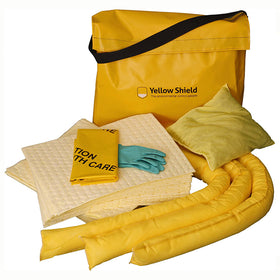
    A tube spill kit is one such spill response component that works really well in all situations. The kit incorporates everything you need to cope with a small general spill, with absorbent pads and socks included in the package. Having an absorbency capacity of around 20 litres, the tube spill kit comes with its own shower proof bag and carry strap so can easily be carried to the spill site.

    Spill kit refills

    Refills are available for many different types of spill kits and are a cost-effective way to replace items you may have used. You can even keep a stock level of spare items at hand, so the bag can be refilled as soon as the components are used. This way you can be ready to tackle the next spill.

    Read now
  • September 7, 2010

    Absorbent socks, pads and pillows

    If you work in heavy industry you will realise the importance of having the right spill cleanup materials at hand. Oil spills from machinery are quite commonplace in an industrial environment and they can present a hazard to members of staff if not dealt with properly.

    Newer mechanical components may be resistant to oil spills but older equipment may not be so good at keeping their contents confined within their metal casings.

    Oil spill socks and pads can be used to great effect to mop up spills from machinery in an industrial environment. The socks can be used as a temporary barrier to stop the patch of oil spreading and pads can be used to soak up the contents of the spill.

    When the above absorbents are used in conjunction with absorbent pillows and granules you can have a comprehensive oil spill cleanup package at your disposal.

    Because all these products are available in easy to access spill stations and in spill dispensers, they can be located at various points around your industrial site so they are readily available for your employees to use.

    Read now
  • September 6, 2010

    Rehabilitation of wildlife takes place after oil spill in the Gulf of Mexico

    BP is working closely with various companies after the oil spill in the Gulf of Mexico, to rehabilitate wildlife back into its natural habitat.

    As well as working closely with Sea Turtle rehab and care at the Louisiana aquatic centre and the Fort Jackson oiled bird rehabilitation centre, BP also has a contract with Tri-State Bird and Rescue.

    Injured or oiled birds can be reported to the Tri-state Bird and Rescue Centre who will recover the birds and clean and release them. People are encouraged to phone the freephone number and not attempt to clean or rehabilitate the birds themselves.

    BP has also set up The Gulf of Mexico Research Initiative which it hopes will be able to assess the damage caused by the Deepwater Horizon spill over the next 10 years. As part of a $500m commitment to the affected region, BP will look at how the disaster has impacted on the environment and how it can improve remediation technologies to help future recovery processes.

    BP is still continuing to use spill containment and clean-up devices in the Gulf and is closely monitoring the affected areas.

    Read now
  • August 30, 2010

    Cleaning and degreasing after a spill

    Every industrial site needs to be adequately equipped with the right cleaning equipment. Keeping your working area clean and tidy will not only mean that you can concentrate on the job you have to do, it will also make the area free from potential trip or spill hazards.

    Cleaning equipment at an industrial site will vary from simple sweeping brushes to industrial degreasing floor cleaners, and every industrial site should have a range of equipment at hand so employees can keep their work area tidy.

    It’s not just the responsibly of the cleaners on site to pick up dirty rags or notice and clean spills, it’s the duty of every employee to make sure that if they notice a problem, they report it and deal with it.

    If you have had a spill or a leak that has been cleaned up using a spill kit, you may still need to remove the residue from the floor surface. If you use an industrial degreaser on the area in question, you can remove the potential slip and trip hazard by making the area clean and also reduce staining of the area.

    Some degreasers can be bought for a specific application such as removing oil or tar whereas others are more general purpose in application.

    Read now
  • August 28, 2010

    Robotic devices to monitor oil spill in the Gulf of Mexico

    Good news for the spill response effort in the Gulf of Mexico. BP is going to use two unmanned wave-gliding machines which will monitor water and marine systems including:

    • Monitoring the water quality including the amount of oil in the water, amount of phytoplankton and dissolved oxygen matter.

    • The number of marine mammals.

    • Weather data.

    The vehicles will start monitoring the area after initial testing and will use solar power to power the electronics in the vehicles and wave power as a form of propulsion.

    BP Gulf Coast Restoration Organisation spokesperson Mike Utsler stated:

    "These vehicles will provide us a steady stream of data about water quality and should significantly increase the available data for ongoing research activity,

    "We will initially deploy the Wave Gliders between the Macondo well and the shoreline, and look to expand from there in the future."

    The vehicles which have been designed by Liquid Robotics will pass their data via a satellite link to a real time monitoring station.

    President and CEO of Liquid Robotics, Roger Hine stated:

    "Initially we will be calibrating a set of nine optical sensors to monitor water quality, including trace amounts of dispersed oil, and will then add acoustic monitoring of marine mammal activity,

    "We look forward to working with BP on this extended research program."

    Read now
  • August 27, 2010

    Spill response training courses

    Managing spills at an industrial site is an important part of a company’s health and safety mandate. And, as part of the process of managing spills, companies should thus have the right spill response products in place. It’s also important of course that staff who may have to deal with a spill are adequately trained and know what to do when a spill occurs.

    Spills happen at inopportune moments and most people who have dealt with a spill and not had adequate training would always say they would have done something differently in their response so the clean-up operation was smoother.

    As part of a spill response plan it’s thus important to not just have the right spill containment and spill clean-up products, it’s also important to have trained staff.

    If you send employees on an accredited spill response course they will be better prepared to deal with any type of fuel or chemical spill you have on site. Some of the courses that are accredited by the British Safety Industry Federation don’t just cover what to do if you have a spill, they also discuss the relevant legislation involved.

    Read now
  • August 26, 2010

    Zoo staff donate hair to help clean up oil spill

    A zoo in East Sussex is doing its bit for the Deepwater Horizon spill response, after staff and visitors donated their shorn hair.

    Approximately 60 people had their hair cut at Drusillas zoo by Icon Stylist’s Jal Clarke. Jal launched his appeal in July when he learned that workers cleaning up the spill were using human hair in booms on the coastline. He had already visited the zoo last month to collect fleeces from llama and alpaca.

    The now hairless people all had their hair cut for free by the stylist who is still on the look out for further hair donations.

    Mr Clarke stated:

    "We have had great support so far from Drusillas but we urgently need a lot more hair or fur for the oil spill catastrophe.

    "The aftermath of the devastation this oil has caused has already destroyed so much sea life. We need to act fast for our future generations."

    Human and animal hair is a good collector of oil based fluids and as such can be used in booms ina spill response effort.

    Read now