

Skip to content
❄ ❄ ❄ Announcement! Despatches are now closed for 2025 and will resume on 2nd January 2026. Click here for more info! ❄ ❄ ❄

News

RSS
  • September 29, 2010

    Industrial drip trays

    There are many uses of drip trays in an industrial environment. From the simple catching of drips from a leaky piece of machinery, to a place to keep liquid storage containers while the contents are being used, they are an essential component of every industrial business.

    Work surface drip trays

    Work surface drip trays are essential for those people who work with liquids on a daily basis. Electrical and mechanical engineers may use these types of trays to place oil cans or liquid lubricants whilst they are being used. Laboratories that use chemicals need to use trays like these so any chemicals that are spilt are contained easily.

    Steel drum drip trays

    Any steel drums that are kept on site should be placed on an appropriate stand so that any leaks or drips are contained. Drum drip trays are the perfect solution in this scenario. They can safely hold a number of drums and any spills when filling or dispensing can be contained.

    Polyethylene drip trays

    Perhaps the type of drip tray that can be used in the widest array of applications is the polyethylene drip tray. Polyethylene drip trays can be purchased in a wide range of sizes and are lightweight and easy to manoeuvre. Absorbent pads can be placed in the tray and can be changed as and when necessary.

    A polyethylene drip tray is essential at any site that uses machinery, where there is a chance there may be a spill.

    Read now
  • September 28, 2010

    Steel fuel bowsers

    If you need to dispense fuel at your industrial site, you need a bunded fuel tank that can take care of all your fuel storage and usage needs.

    Steel fuel bowsers are made in accordance with the latest Oil Storage Regulations 2001 and come in many different sizes. They can be used for refuelling your vehicles, as a secondary tank for generators or even for storage of fuels such as diesel, paraffin or kerosene.

    Steel bowsers are available in capacity sizes up to 1,400 litres and have a bund capacity of 110%, so if the inner tank fails the contents of the bowser will be contained. Most come with a lockable cabinet where the pump can be housed and some can be customised, so you can choose the type of pump you want and the control equipment that fits your specific application.

    In some situations, you may need a bespoke steel bowser design to meet application needs. This can also be catered for by specialist fuel tank suppliers.

    All steel bowsers should now be manufactured to OFTEC standard OFS T200.

    Read now
  • September 27, 2010

    Can the UK cope with an oil spill of the magnitude of Deepwater Horizon?

    There have been industry wide calls for a ban on deepwater drilling after the recent Deepwater Horizon disaster in the Gulf of Mexico. But only on Friday the members of OPSPAR – countries with shorelines around the eastern Atlantic, including Britain, rejected the proposals put to them regarding a ban.

    The Department for Energy and Climate Change are currently considering three deep wells off Shetland, two run by Chevron and one by BP. So the question that should be asked is - “How ready is the UK, to cope with a spill of the magnitude of the recent spill in the Gulf of Mexico?”

    Reviews are currently taking place industry wide into how to improve the chance of avoiding a similar catastrophe and critics still say that the industry was and is still underprepared. They say that deep water drilling should not take place until the failings that happened are more understood and practices are put in place industry wide to eliminate potential problems.

    Greenpeace protestors recently climbed onto the anchor chain of the drill ship Stena Carron, off Shetland, in protest and lawyers of the firm are looking to get a Judicial Review into the handling of deep wells off the UK’s shores.

    A Greenpeace spokesperson stated:

    "It's irrational to rush ahead with deep water wells. Our worry is that there could be another catastrophic blowout and it could be incredibly difficult, nigh on impossible, to stop it.

    "Whatever the governments say about the plans being robust, history has shown us time and time again that there always will be things like human error. And when you do that in ultra-deep waters like off the west of Shetland, the problems are magnified."

    Read now
  • September 26, 2010

    Footage from Gulf oil spill realises volume estimate

    New video footage of the oil that leaked from the damaged well in the Gulf of Mexico has just been released. And the footage has led to the ratification of the estimated volume of oil spilled, initially realised by US federal government advisers.

    In total, the estimate of the amount of crude oil that leaked into the Gulf of Mexico is now 4.4 million barrels. The well leaked uncontrollably from the 22nd April until the 15th July and the oil released was enough to fill four Olympic swimming pools every day.

    Using optical plume velocimetry, marine biologists Maya Toistoy and Timothy Crone were able to gauge the velocity of the oil leaking from the damaged blow out preventer after closely examining the footage.

    Dr Crone explained:

    "Using this optical image analysis method we can apply essentially a conversion factor for what the apparent motion is and obtain what the average velocity is at the opening,

    "And if you know the average velocity at the opening, you can then multiply that by the area of the opening and that gets you the volume. The work relies heavily on laboratory experiments which we have used to calibrate this method,"

    The team, from Columbia University, reported their findings in the popular ‘Science’ journal.

    Read now
  • September 25, 2010

    Spill pallets and spill sumps

    Industries that use oil drums have to pay careful attention to the way they store their drums in case there is a spillage of liquid. Liquid stored in drums can be hazardous to health and the environment and hence provisions must be made to keep both employees safe and stop environmental damage. A good spill control device to use in these situations is called a spill pallet or sometimes a sump pallet. If you use spill or sump pallets under your drums, any liquid can be carefully contained.

    A spill pallet will catch any drips or leaks from drums, and because the pallet has a capacity which is usually in excess of the volume capacity of the drums stored, even if the entire contents of the drum spill they can be carefully contained.

    Drum pallets can be purchased in a wide range of sizes, suitable for differing amounts of drums. Most are now made of durable and chemical resistant polyethylene and have forklift pockets underneath so they can be transported from location to location easily.

    Spill pallets are also available that can hold IBCs, so the contents of these liquid storage devices can also be protected from spillage situations.

    Read now
  • September 24, 2010

    Bunded storage facilities

    There are many different types of liquid storage containers. However, those that contain substances that may be hazardous to health or the environment have to comply with certain regulations so they can be classed as being safe to use. Different liquid storage options include:

    Bunded storage

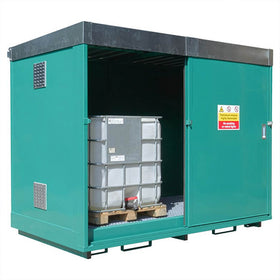
    Bunded storage provides a storage facility that does not just provide a place to put your liquid containers; it also provides a bund which can hold the contents of the containers if they are damaged, so that they will not escape to the surrounding environment. Bunded storage enclosures are made especially to hold liquid drums or IBCs.

    Bunded tanks and single skin tanks

    Bunded tanks can be either made from polyethylene or steel and comply with the Oil Storage Regulations 2001. The tanks have a bund that is usually 110% larger then the capacity of the tank so they can stop the liquid spilling if the inner tank fails.

    Single skin tanks are suitable for storage of domestic heating oil and fuel oil. There are regulations where a single skin tank can be sited because it does not have a bund, so you need to contact a spill control advisor before purchasing a tank.

    Read now
  • September 23, 2010

    Oil washes up on Southend and Canvey beaches

    An oil slick has washed up on a beach in Essex. The spill, which is approximately 500 litres of heavy duty oil, leaked from a ship in the Thames Estuary late on Sunday.

    The oil has affected a stretch of beach approximately four miles long near the Southend Sea Life Centre with parts of the Canvey beach also affected.

    The spill cleanup operation has already started with Southend Borough Council and Castle Point Council already taking steps to remove the pollution. Members of the public have been asked to keep off the beaches until the spill clean-up has been completed.

    The sea Life centre usually takes its water from the Thames Estuary but has had to dump the water it was using, the curator David Knapp stated:

    "We have now taken all the appropriate steps now to ensure the safety of all the inhabitants of the Sea Life Adventure.

    "The bigger concern, of course, is the marine fauna, particularly those animals which float at the surface and scavenge in the intertidal zone, like seabirds."

    Read now
  • September 22, 2010

    Make sure staff are trained at spill control and prevention

    If you have a potential risk on site, it’s important that all your staff are trained regarding the risk, so they know the steps to take should there be an accident.

    Preparation can make accident response times tumble, as the workers who respond will know how to cope with the situation and take the right steps straight away. And this is becoming increasingly important at industrial sites that use harmful liquids such as chemicals and fuel.

    If your staff are trained at coping with spills at your industrial site, they will be able to respond quickly and potentially stop the situation from becoming worse. Or at the very least, use a minimal amount of time and equipment to clean up the spill, improving workload efficiency times.

    Trained staff can also make recommendations on the type of spill equipment you should have to hand at different locations. And can make other staff aware about their responsibilities regarding the dangers of not containing and cleaning spills.

    If you or your staff need training on spill control, it’s worthwhile attending a spill control training course. During the course, the course instructor will discuss the best way to deal with different types of spills and how to choose and use the right spill control equipment.

    Read now
  • September 21, 2010

    Control of dangerous liquids

    If you have hazardous substances on site, you need to make sure that you comply with the Control of Substances Hazardous to Health (COSHH) Regulations 2002. These regulations set out how you can work with hazardous substances safely and how you can protect your employees.

    If you run a business, it’s important to make a profit, and having unhealthy workers who may make a claim against you is not the place to start. It can be time consuming to conform to current standards, but they have to be adhered to, so it’s sometimes the case that you may have to take professional advice about the substances you use and how you can comply with the current regulations.

    Liquid hazards

    The containment and storage of hazardous liquids falls under the remit of COSHH. So you need to make sure that you are aware of the potential hazards and the regulations regarding the storage of these liquids.

    Some liquids can pose a threat to workers because of the chemical constituents in the liquid that may come into bodily contact with the worker, some liquids are flammable and some give off noxious gases that when inhaled can cause respiratory problems.

    If you don’t know the dangers of the liquids on your site, you can check the information on the product, ask the supplier of the product or even check the HSE’s website for more information.

    Read now